
Podcast: Play in new window | Download
Subscribe: Apple Podcasts | RSS
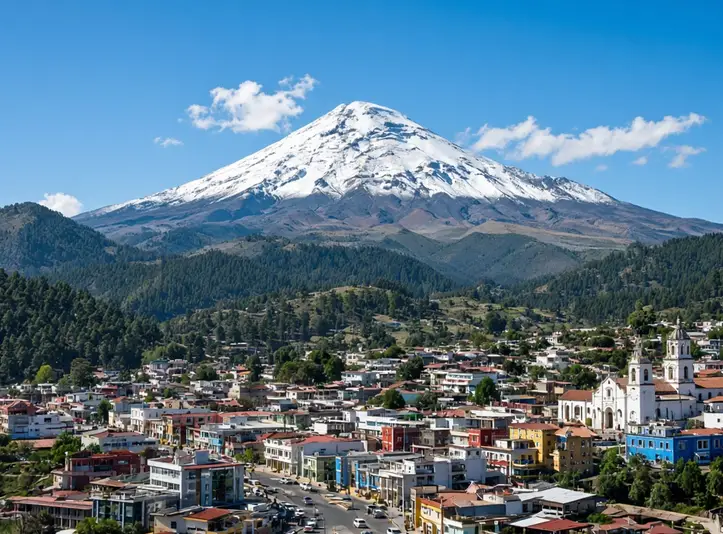 Rising approximately 18,491 feet above sea level on the border of Veracruz and Puebla, Pico de Orizaba—known in Nahuatl as Citlaltépetl, or “Mountain of the Star”—is Mexico’s highest peak and the tallest volcano in North America. Its year-round snow-capped cone dominates the landscape, visible for vast distances, and has long inspired awe among the peoples who lived in its shadow. Pre-Hispanic cultures, including the Olmecs, Nahua, and Totonacs, regarded the mountain as sacred. It appears in cosmologies, religious beliefs, and ritual landscapes. Over centuries, oral traditions, later written accounts, and living mountain lore have woven a rich tapestry of legends around it. These stories explain its origins, its names, its relationship to other volcanoes, and even the presence of a remarkable modern guardian.
One of the oldest and most enduring tells of Nahuani, a courageous and beautiful warrior woman renowned for her skill and justice. She was never alone; her constant companion and trusted advisor was a magnificent fishing eagle (or osprey) named Ahuilizapan. The two shared an unbreakable bond. Nahuani fought many battles, and the eagle soared above her, offering guidance and loyalty. In one great confrontation, Nahuani was finally defeated and killed. Overcome by grief, Ahuilizapan rose higher and higher into the sky until she could climb no farther. Then, in despair, she folded her wings and plunged earthward with tremendous force. Where she struck the ground, the earth began to swell. Over time a mountain grew, then a volcano. The spirit of the faithful eagle remained within it. Whenever Ahuilizapan remembered the loss of her beloved friend, fury rose inside her and the mountain erupted. To calm this wrath, people of the surrounding communities climbed the slopes bearing offerings and paying homage to the memory of Nahuani, the warrior whose friendship had given birth to the peak.
A different and equally powerful set of traditions accounts for the Nahuatl name Citlaltépetl. These center on Quetzalcóatl, the Feathered Serpent, god of wisdom, wind, learning, and the morning star Venus. Several versions exist, reflecting the fluid nature of oral tradition and later colonial retellings. In one widely told account, Quetzalcóatl, after leaving the Toltec city of Tula following a betrayal that forced him to break his vow of celibacy, journeyed across the land with a handful of disciples. He eventually reached a high point from which he could see the great volcano. There he bade his followers farewell, promising that he would return when the Fifth Sun appeared on the horizon. When they asked how they would recognize the sign, he performed magical gestures. The volcano erupted; a column of fire and ash rose and joined with the morning star Venus, which blazed more brightly than ever. He named the star Tlahuizcalpantecuhtli—“Lord of the Dawn”—the herald of the coming sun. Other endings to this story diverge. Some say he continued to the coast at Coatzacoalcos, boarded a raft of intertwined serpents, and sailed eastward until he vanished into the horizon. From that horizon a brilliant star later rose, crossed the sky, and settled directly above the volcano’s crater before disappearing into it, as if returning to the mountain. A nineteenth-century account recorded by Joaquín Arróniz in his Essay on the History of Orizaba describes Quetzalcóatl dying at Coatzacoalcos. His body was wrapped in fine garments, placed in a golden urn, and carried to the summit of the active volcano. There it was consumed by fire. The ashes formed a dense cloud that darkened the sky for four days. When the darkness lifted, a radiant star appeared above the white peak, representing Quetzalcóatl. From that moment the mountain was called Citlaltépetl, the Mountain of the Star.
Still another telling places the transformation on the volcano itself. Quetzalcóatl climbed the slopes seeking the path to eternity. At the crater, fire engulfed his body, but his soul took the form of a resplendent quetzal bird. The bird’s brilliant plumage shone like a star as it flew into the sky. Locals in Coscomatepec and nearby towns still note that, in autumn and winter, Venus appears to move across the sky and set near or over the crater, reinforcing the ancient association. The mountain was also known earlier as Poyauhtecatl, “the one who colors” or “he who dwells among the light clouds,” reflecting both its luminous snowcap and its role in rituals connected with cold and mist.
The three highest volcanoes of central Mexico—Pico de Orizaba, Popocatépetl, and Iztaccíhuatl—are linked in a tragic romantic cycle that treats the peaks as living characters. In the classic legend of Popocatépetl and Iztaccíhuatl, the warrior and the princess are denied marriage until he proves himself in battle. A jealous rival named Citlaltépetl spreads the false rumor that Popocatépetl has died. Grief-stricken, Iztaccíhuatl dies. Upon his return, Popocatépetl carries her body to a high ridge, builds a tomb, and remains beside her with a smoking torch. Over time they become the familiar snow-covered forms: the sleeping woman and the kneeling warrior whose occasional eruptions express undying sorrow.
In variants that incorporate Pico de Orizaba, Citlaltépetl is the jealous third party. One older telling, recorded in the nineteenth century, claims that Iztaccíhuatl was unfaithful to Popocatépetl with Citlaltépetl. When the husband discovered them, he killed his wife in a rage. Citlaltépetl froze in mid-flight, forever fixed as the distant high peak, while Popocatépetl remained frozen in remorse beside the body of the woman he had slain. Another version punishes Citlaltépetl for his deceit by transforming him into the tallest mountain in Mexico, condemned to watch from afar the eternal, unbroken love of the two lovers he could not separate. In all these stories the geography itself becomes moral landscape: distance, height, snow, and smoke express loyalty, jealousy, grief, and endurance. These ancient narratives established the mountain as a place of spirits, transformation, and watchful presence.
In the modern era a new legend arose that feels continuous with the older ones: the story of Citla, the mixed-breed dog who became the living guardian of the peak. Citla’s origins are themselves the stuff of mountain lore. The most common account holds that, years ago, a mason or construction worker brought a puppy with him for company when traveling to Sierra Negra, the neighboring peak that hosts the Large Millimeter Telescope. When the work ended, the dog refused to leave. Other versions suggest he was orphaned after his mother was struck by a vehicle, or that he simply appeared near the alpine refuges and never departed. Whatever the precise beginning, Citla chose the high country above 13,000 feet as his permanent home and was named after the mountain itself: Citlaltépetl shortened to Citla. Over more than a decade, according to the legend, he adapted to conditions that kill most animals. His paw pads thickened for travel on snow and rock. His coat grew denser. Citla was also said to have had an unusually large heart. He endured temperatures well below freezing—down to about 12°F or colder—and the thin air of altitudes over 16,000 feet. When climbers were absent he hunted squirrels and rabbits; when they were present he preferred salami, dried meat, sausages, tuna, and roasted chicken offered by mountaineers. He never voluntarily descended below roughly 13,000 feet and refused to enter vehicles. According to the many stories, Citla became an unofficial but extraordinarily effective mountain guide with some claiming he was the spirit of an experienced mountaineer. The dog knew the principal routes on the south face of the volcano and frequently accompanied parties all the way to the summit. More remarkably, he appeared to sense when people were lost, exhausted, or suffering from altitude sickness. He would stay beside them, bark to draw attention, and lead them at a deliberate pace toward a refuge, the surveillance cabin near the telescope, at about 13,780 feet, or the high refuge near 15,289 feet. Climbers from Mexico, Japan, Germany, Australia, Brazil, and elsewhere told the same stories: in fog, darkness, or sudden storms, the white dog with the black-marked face would materialize and guide them to safety.
One often-repeated rescue occurred in October 2012. A family of seven, delayed by hours, was caught in a snowstorm above 13,000 feet. Hypothermia set in. Around two in the morning, as the snow eased but the cold and fatigue remained, they heard barking. Citla appeared, wagged his tail, walked slowly ahead, sat and waited when they lagged, and led them to refuge. No owner was found; the dog simply performed the work of a guardian. He bore the scars of his life. Fights with coyotes marked his face from puppyhood. On one occasion he was viciously attacked by a large dog brought up the mountain; the wounds included a severed jugular, broken ribs, and a fractured leg. He took shelter in the surveillance cabin, was found by climbers, and received veterinary care funded by the alpine community. He recovered fully and returned to the high slopes. In one story, a mountaineer even fitted him with dark glasses to protect his eyes from the blinding reflection of the snow but later in life the dog lost much of his sight to the cumulative effect of that glare. A small shrine exists in memory of this legendary dog high on the mountain. Climbers visit the site, leaving flowers and sharing stories. Many call this phantom dog “the angel of the snow,” “the guardian of the mountain,” or simply “the dog of the snow.” In the collective memory of those who climb Citlaltépetl, Citla occupies a place continuous with the older legends. Just as the spirit of Ahuilizapan is said to inhabit the volcano, and just as Quetzalcóatl’s star is said to rest above its crater, the dog is remembered as a protective presence that appeared when needed and guided the lost. The mountain that once received the ashes of a god and the grief of an eagle now also holds the memory of a loyal dog who chose its harsh slopes as home and spent his life watching over those who tried to reach its summit. Pico de Orizaba remains a place where geology, history, and story converge. Its ancient names and myths record how Indigenous peoples understood a towering, snow-covered volcano as a site of stars, spirits, friendship, jealousy, and transformation. Its modern legend of Citla shows that the mountain continues to generate tales of guardianship and fidelity. Together these stories—Olmec, Nahua, colonial, and contemporary—keep the Star Mountain alive not only as a physical summit but as a landscape of enduring meaning.