
Podcast: Play in new window | Download
Subscribe: Apple Podcasts | RSS
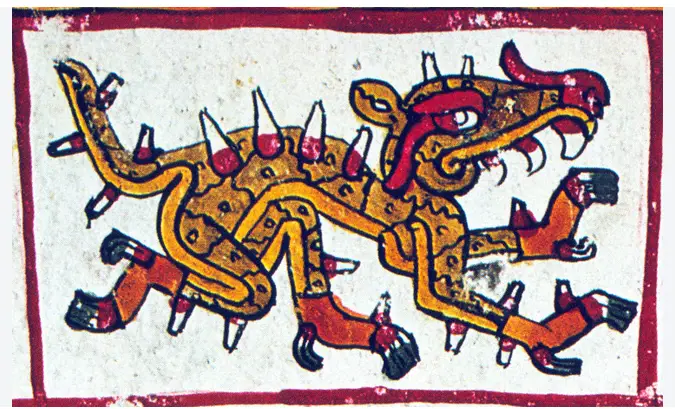 Cipactli is a Nahuatl term meaning crocodile, caiman, or alligator. Dictionaries and colonial glosses also treat it as a mythical reptile, sometimes rendered as dragon or monster, and as the name of the first day sign in the 260-day ritual calendar known as the tonalpohualli. Related vocabulary includes acipactli, used in central Mexico for the sawfish and interpreted as “the spiny one of the sea.” The word therefore covers both observable animals and a composite being used in cosmogony, calendrics, and art.
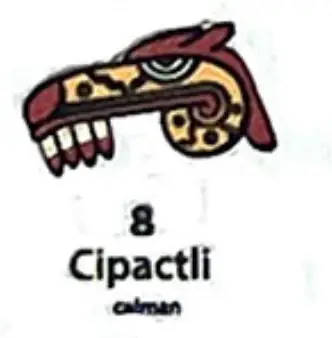
As a calendar sign, Cipactli opens the sequence of twenty day names. Each name combines with a coefficient from one to thirteen. The combination One Cipactli also names a trecena, a block of thirteen days. Colonial-period commentary describes Cipactli as a generally favorable sign associated with beginnings, work, and advancement. Its patron in standard lists is Tonacatecuhtli, a deity of sustenance. Cipactonal, “sign of Cipactli,” is identified as a diviner in early myths. In later narrative, Cipactonal and Oxomoco are the pair who establish the calendar at the instruction of Quetzalcoatl. The placement of a crocodilian sign at the start of the count is consistent with a wider Mesoamerican pattern in which the earth is imagined as a reptile floating on water. In the Maya tzolk’in the corresponding day is Imix. Zapotec and other neighboring counts use related earth-reptile or water-creature signs in the same initial or near-initial position, which indicates a shared calendrical structure older than the Aztec Empire.
 The same name designates a primordial aquatic monster in central Mexican creation accounts recorded in the sixteenth century from indigenous paintings and oral testimony. Like many myths in ancient Mexico, these accounts are not uniform. They differ on whether the gods first create the creature or find it already present, on the creature’s sex, and on how closely Cipactli is identified with Tlaltecuhtli, the gender-ambiguous earth deity whose name means “earth lord” or “earth lady.” The shared outline is stable enough to summarize. Before the present world is ordered, there is a mass of water. Cipactli inhabits that water. Sources describe the creature as part crocodile, part fish, and part toad or frog. It is said to be continually hungry. A recurring iconographic and narrative detail is the presence of additional mouths at the joints. Because the monster consumes whatever is placed in the water, the creator gods cannot complete a durable surface for human life. Some summaries assign the initial creative work to four gods associated with the cardinal directions after a long interval following their own origin from the dual deity Ometeotl. Tezcatlipoca and Quetzalcoatl undertake the defeat of the monster. In the best-known episode, Tezcatlipoca uses his foot as bait. Cipactli bites and Tezcatlipoca loses the foot, a loss later marked in images by an obsidian mirror in place of the limb. After a struggle, the two gods pull the body apart. One portion becomes the sky and the other the earth. Some versions specify a division into multiple layers: thirteen upper worlds associated with the head or anterior body and nine underworlds associated with the tail, with human life located between them. Wooden supports or trees are introduced to keep the halves separated so that a habitable middle space remains. Body parts are assigned to landscape features. Eyes become springs and wells. Hair becomes vegetation. Skin becomes grassland. Shoulders and back become mountains. The mouth corresponds to caves and river openings.
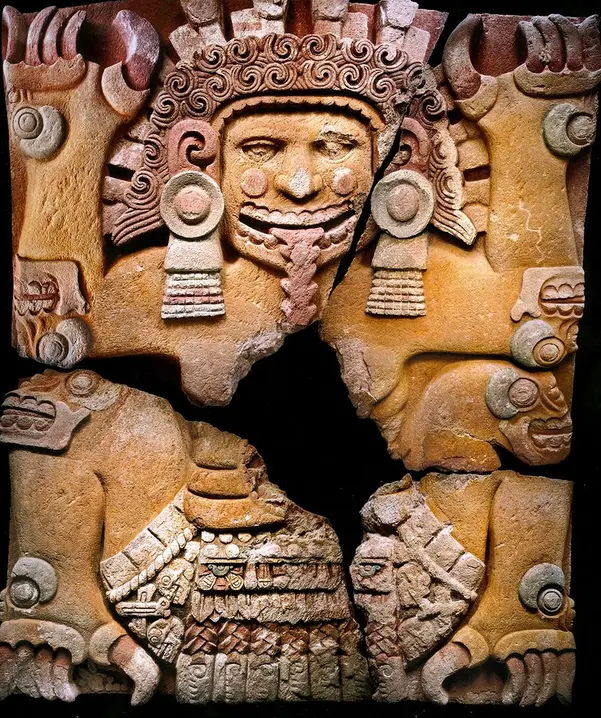 The texts and oral traditions state that the being is never annihilated. The earth remains a living, hungry body. Blood offerings, including human sacrifice in Aztec state ritual, are explained as payment that keeps the land productive and the cosmic structure in place. Earthquakes are described as the stirring or stretching of that body. When the same complex is treated under the name Tlaltecuhtli, the earth being is often shown as a squat, clawed figure with an open jaw, frequently carved on the underside of monuments so that the image faces the ground. Gender attribution varies by source: some passages treat the monster as female, others as male, and some use a grammatically masculine title for a being depicted with female attributes. A large monolith of Tlaltecuhtli recovered at the Templo Mayor in 2006 measures about four by 3.6 meters and weighs nearly twelve tons, illustrating the official scale of earth-monster imagery in the imperial capital.
The Historia de los Mexicanos por sus Pinturas states that the gods made water and in it raised a large fish called Cipactli, “which is like a caiman,” and from that fish they made the earth, called Tlaltectli, depicted as an earth god lying on a fish because the land had been made from it. The mixed description matches pictorial practice. Aztec and related manuscripts show a hybrid: crocodile head, serpent teeth and tongue, in some cases a sawfish rostrum extending the snout, a body drawn as reptile or fish, a tail that can resemble a shark’s, and a hide covered with spines. The sawfish component has an archaeological counterpart. Work at the Templo Mayor in Tenochtitlan has catalogued more than sixty sawfish specimens from the sacred precinct, a high number relative to other vertebrates recovered there. The concentration indicates that acipactli was a preferred offering animal and that its morphology was available as a model for the mythical hybrid.
Crocodile-inspired earth imagery is not limited to the Late Postclassic Basin of Mexico. Formative-period Olmec-style reliefs at Chalcatzingo in Morelos show crocodilians with upturned mouths from which rain clouds emerge. Researchers have connected this motif to a belief that wind and rain come out of caves, treated as openings in a living earth. Portable greenstone sculptures show similar poses. Among Maya groups, Imix is linked to water, the earth surface, and crocodilian or water-lily imagery. In the K’iche’ Maya Popol Vuh, Zipacna (Sipakna) is the elder son of Seven Macaw. He boasts that he made the mountains. He is killed through deception by the Hero Twins and associated with burial under a mountain. Linguists and Mayanists have argued that the name derives from Nahuatl Cipactli or from a shared Mesoamerican crocodilian complex; the character is a narrative giant rather than the earth’s body itself, but the association with landforms belongs to the same set of ideas. Twentieth-century Highland Maya tradition retains a demon called Sipak. A hill near Rabinal, Guatemala, elongated and compared locally to a crocodile, is named Sipak and is sometimes identified with the buried figure.
 Mixtec screenfolds, including the Codex Vindobonensis, link the crocodile day to dynastic origins. A separate Aztec tradition uses TeoCipactli, “divine crocodile,” for a flood survivor who escapes in a canoe and takes part in repopulating the earth. Among the Huastec, one underworld layer is called Cipactlan, “place of Cipactli,” where the monster helps support the earthly plane. These variants show a regional system rather than a single fixed myth: a spiny aquatic reptile stands for the earth, for beginnings, and for dangerous fertility.
The animals underlying the image are based on real species. Morelet’s crocodile occupies rivers and wetlands in southeastern Mexico and adjacent regions. The American crocodile occurs along both Mexican coasts. Spectacled and related caimans inhabit suitable lowland waters. Sawfish were historically present in Mexican coastal and estuary systems and have declined through fishing and habitat loss. These species supplied the visual and behavioral traits—armor, teeth, ambush hunting, a life split between water and bank—that became the foundations for the myths and metaphors.
Claims that Cipactli survives as an unidentified animal are not supported by a body of field reports comparable to those assembled for lake monsters or large hominids. Popular cryptozoological lists sometimes include Cipactli and Tlaltecuhtli among pre-Columbian mystery beasts, but they classify them as mythological entries. No verified modern specimen, carcass, or systematic sighting record attaches to the name. What does continue is use of the figure in landscape, ritual practice, and media. A petroglyph near Temamatla in the State of Mexico shows a Cipactli from which a human face emerges. The stone includes a concavity interpreted as a receptacle for liquid offerings and has been discussed in connection with equinoctial sunrise over Iztaccíhuatl. In Guerrero, caiman dances employ masks and costumes fitted with pochote-tree spines along the back, a construction compared with the painted spines of the earth crocodile. The Sipak hill and related oral accounts in highland Guatemala keep a local geographical name tied to the Popol Vuh episode.
Twentieth- and twenty-first-century works reuse the name with varying accuracy. The television series From Dusk Till Dawn produced a water-associated Mesoamerican monster developed by the effects studio KNB; publicity connected the design to Cipactli while treating it as a fictional river threat rather than a reconstruction of codex iconography. The game “Mictlan: An Ancient Mythical Tale” presented Cipactli as a primeval sea monster with mouths at the joints. A Mexican film collective released a short movie titled Cipactli in 2020. A Salvadoran documentary, Cipactli, the Crocodile Goddess, examines local rock art and uses the name as a frame for regional crocodile and creation imagery. Fiction has employed Zipacna or Sipacna as a named figure, including in Louis L’Amour’s The Haunted Mesa and in later novels that draw on Maya narrative. The day sign remains in use among people who keep the tonalpohualli and appears as a given name. These appearances do not constitute evidence of a living monster. They show that the term still functions as a label for earth, origin, and hazard.
Some fringe Mexican UFO researchers claim that references to Cipactli and intelligent crocodile-like creatures in pre-Hispanic Mexico point toward evidence of ancient visitations by the alien race known collectively as “The Reptilians.” In UFO lore, the Reptilians (or Reptoids) are a race of shape-shifting humanoid reptiles often depicted as covertly controlling human society by infiltrating governments and elite circles. They are typically said to originate from the Draco constellation or from underground bases deep within the Earth.
Cipactli is, in documented usage, a word for crocodilian animals, a day name, and a mythic body from which gods fashion the world. Its hybrid form in art combines crocodile, fish, serpent, and sawfish traits. Its narrative function is to supply matter for earth and sky at the cost of an ongoing ritual debt. Its range as an idea runs from Olmec settlements through the Aztec capital to Mixtec dynastic books and Maya epics. Its modern afterlife is cultural: carvings still in place, dances, films, games, local hill names and fringe UFO theories. The crocodiles and sawfish that informed the image are zoological facts. The claim that their mythic counterpart still occupies a particular body of water is not supported by evidence, however.
REFERENCES