
Podcast: Play in new window | Download
Subscribe: Apple Podcasts | RSS
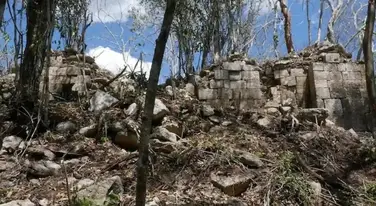 Deep in the dense, protected rainforest of Mexico’s Calakmul Biosphere Reserve in Mexico’s state of Campeche, archaeologists have uncovered a remarkably intact ancient Maya city that had lain hidden for over a thousand years. Researchers named the site Minanbé, a Yucatec Maya phrase meaning roughly “there is no path” or “there is no road.” The site offers a rare, unlooted window into the Late Classic to Terminal Classic periods of the Maya Civilization which was roughly from 600 to 950 AD. This 37-acre settlement was not a sprawling metropolis like nearby Calakmul or Tikal but held its own as a significant regional center with plazas, elite architecture, water management systems, agricultural terraces, and an impressive array of carved monuments. Its preservation—free of the looting pits and missing building materials that plague many sites—makes it a treasure for researchers seeking insights into Maya political, religious, and environmental dynamics just before the widespread abandonments of the 10th century.
Ivan Šprajc, affiliated with Slovenia’s Research Centre of the Slovenian Academy of Sciences and Arts, has spent three decades surveying the Central Maya Lowlands. His project, authorized by Mexico’s National Institute of Anthropology and History, or INAH, has previously identified major sites like Chactún in 2013. LiDAR (light detection and ranging) aerial laser scanning played a pivotal role. Conducted years earlier as part of broader regional mapping, these scans penetrated the thick jungle canopy to reveal subtle topographic anomalies west of Chactún in the northern sector of the Calakmul Biosphere Reserve giving researchers hints of structures beneath the vegetation.
It took until the 2026 field season for ground verification. The team that set out to confirm the LiDAR signatures was comprised of 3 Mexican archaeologists their 2 Slovenian colleagues, plus about a dozen local workers from the community of Constitución. What they encountered was not a straightforward hike but an expedition that tested physical limits and underscored the site’s extreme isolation.
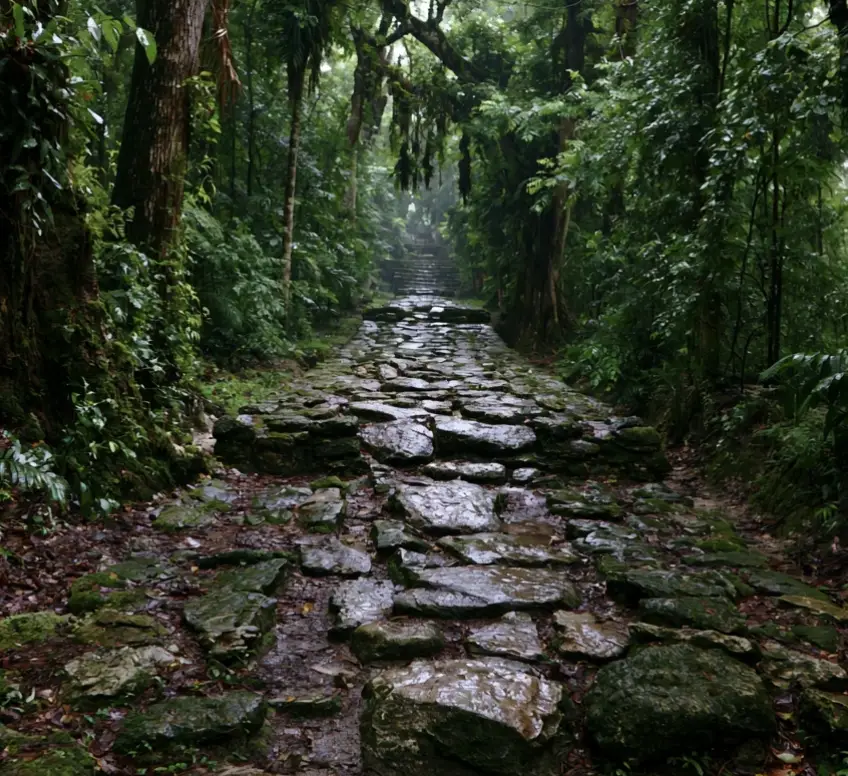 Minanbé lies miles deep in the protected rainforest of the Calakmul Biosphere Reserve, one of Mexico’s largest protected areas and a UNESCO World Heritage site renowned for its biodiversity and archaeological richness. The region features dense tropical forests, wetlands, and rugged terrain with no modern infrastructure nearby. Crucially, unlike many other jungle sites accessible via old logging roads from past timber exploitation, Minanbé had none. This absence of any pre-existing trails or paths is exactly why the team named it Minanbé and why it remained untouched. To reach the site, the explorers first followed whatever faint forest paths existed, then used ATVs or quads. When vegetation became too dense, they resorted to clearing a path with machetes and chainsaws for approximately 3 miles. After that, they continued on foot for another similar distance—roughly another 3 or 4 miles —through thick undergrowth, mud, heat, and insects under the tropical sun. The total off-trail effort amounted to a grueling multi-day trek through virgin jungle.
Exact distances to the nearest permanent human habitation are not publicly detailed in initial reports, but the logistics make clear it is extremely remote and likely many miles beyond any established settlement or road. Workers from Constitución participated, indicating the closest logistical base was still a significant journey away. This isolation, while exhausting for the team, proved invaluable: it protected the site from looters for centuries. Šprajc noted it was the first intact site his team had found in three years. The name Minanbé perfectly captures this reality. As Šprajc explained: “Compared to other places where we did surface surveys, access here was much more difficult; however, in the last three years, this is the first one we’ve found intact, with no signs of looting. It was a discovery, a great surprise… That’s why we chose the name of Minanbé, which comes from the Yucatec Maya mina’an, ‘there is no,’ and bej, ‘path’. Thus, we follow the tradition in Maya archaeology of naming some sites according to some characteristic of the place or in allusion to the circumstances of the discovery.”
 Once on site, the team confirmed a complex, planned settlement spanning about 15 hectares. It features a clear urban core with plazas surrounded by palatial structures that may have been elite residences or served to house administrative services, and religious/ceremonial buildings. Agricultural terraces suggest intensive farming to support the population, while wetlands and hydraulic channeling systems demonstrate sophisticated Maya engineering for water management which was critical in a region with heavy seasonal rains and the need for reliable water storage or drainage. A prominent causeway —an elevated roadway typical of Maya urban planning—connects the central sector to the northeastern part of the site. This infrastructure facilitated movement, possibly processions or trade, and aided drainage. Along or associated with this causeway, particularly in the northern areas explored, archaeologists documented monuments arranged in a row. The most imposing structure is a pyramid temple rising more than 43 feet, which is roughly the height of a four-story building. It exemplifies the Río Bec architectural style, common in the region during the Late Classic period, characterized by fine masonry, smooth panels on the facade, a steep central staircase, and decorative moldings at the top. One of the Slovenian archaeologists present, who examined it closely, remarked: “It is the first time I have recorded a more or less well-preserved temple, and a stela still with glyphs.” In some reports, three stelae were noted at its base, slathered in inscriptions that are waiting to tell the tale of this enigmatic place.
The overall layout reflects high degrees of urban planning and landscape modification. Plazas served as public or ceremonial spaces, flanked by structures that likely housed elites or hosted rituals. Terraces on surrounding slopes supported agriculture, integrating the city with its productive hinterland. Hydraulic features—canals and channels in wetland areas—point to advanced control over water resources, a hallmark of Maya adaptability in the tropical lowlands. The site appears as a “fossilized” archaeological landscape, consistent with the heavily transformed environment of the Central Maya Lowlands, which supported an estimated 9–11 million people during the Late Classic peak.
One of Minanbé’s most striking features is its collection of freestanding carved stone monuments: 14 stelae and altars. These were strategically placed, many along the causeway or in prominent locations. They include both round and rectangular altars, with several bearing hieroglyphic inscriptions and iconographic scenes despite some erosion of the limestone surfaces. The standout is Stela 1, the first monument the team noticed. It depicts a dramatic decapitation scene: a figure wielding what appears to be a knife or axe over another individual. Above or associated with this is a calendrical sign recording the date 5 Ajaw, corresponding to 849 AD in the Gregorian calendar. Epigrapher Octavio Esparza Olguín analyzed the glyphs using photographs and 3D models created from hundreds of images. He noted that these and other inscriptions suggest at least some monuments were erected during the Terminal Classic, close to the period of regional site abandonments in the 10th century.
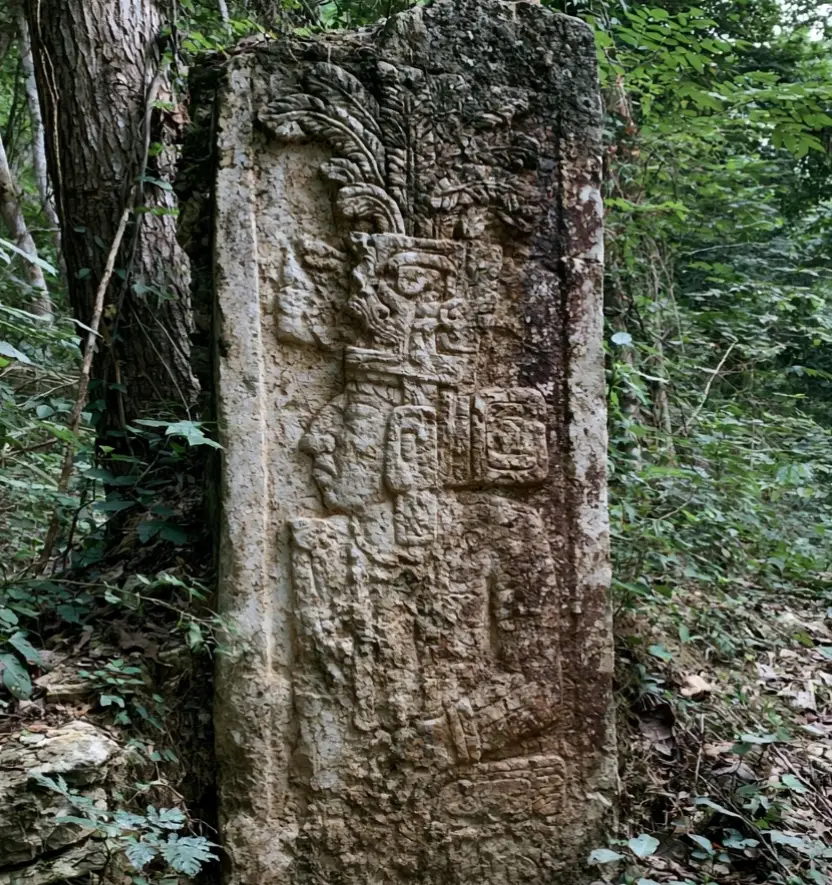 Other monuments show signs of intentional alteration or fragmentation in antiquity—possibly by later groups who arrived after the site’s peak and reinterpreted or rejected earlier power symbols. One example is Monument 6, a fragmented piece preserving the image of a ruler with a feathered headdress, pectoral, wristlets, and collars, along with glyph cartouches. A partial Long Count date on one monument may point to the late 7th century, potentially making it among the earliest recorded in the immediate area. These monuments indicate Minanbé held political and religious importance in the regional hierarchy. The presence of elite iconography and calendrical records ties it to broader Maya traditions of commemorating rulers, rituals (including possible sacrifice), and historical events. Some alterations hint at post-abandonment dynamics, such as incursions or shifts in belief systems by groups from other parts of the Yucatan Peninsula.
Minanbé is modest in scale compared to giants like Calakmul but punches above its weight due to its intact state and the insights it provides. It reinforces the picture of a densely populated, agriculturally intensive landscape in the Late Classic Maya world. The hydraulic and terrace systems underscore environmental management skills, while the monuments offer chronological anchors near the civilization’s transformative “collapse” phase which is better understood today as a complex process of political fragmentation, environmental stress, and migration rather than a total unexplained disappearance. The discovery culminates decades of Šprajc’s work and opens avenues for further research, including detailed mapping, ceramic analysis, more inscription decipherment, and perhaps targeted excavations. Conservation will be key, given the site’s location within a protected biosphere reserve. Its remoteness, once a barrier to discovery, now aids preservation. In an era when many archaeological sites face threats from looting, development, and other natural and human factors, Minanbé stands as a testament to the jungle’s protective power and the persistence of explorers. As Šprajc and his team continue their analysis, this “city without a path” promises to illuminate paths of understanding into one of history’s most fascinating civilizations, revealing not just stones and glyphs, but the lives, beliefs, and ingenuity of the people who built it.
REFERENCES
Ontiveros Valdés, Constanza. “Undisturbed Ancient Maya City Discovered in Mexican Jungle.” The Art Newspaper, July 1, 2026.Šprajc, Ivan, et al. “Minanbé: Un Nuevo Sitio Maya Intacto en la Reserva de la Biosfera Calakmul, Campeche.” Report summarized in INAH communications and field notes, 2026