
Podcast: Play in new window | Download
Subscribe: Apple Podcasts | RSS
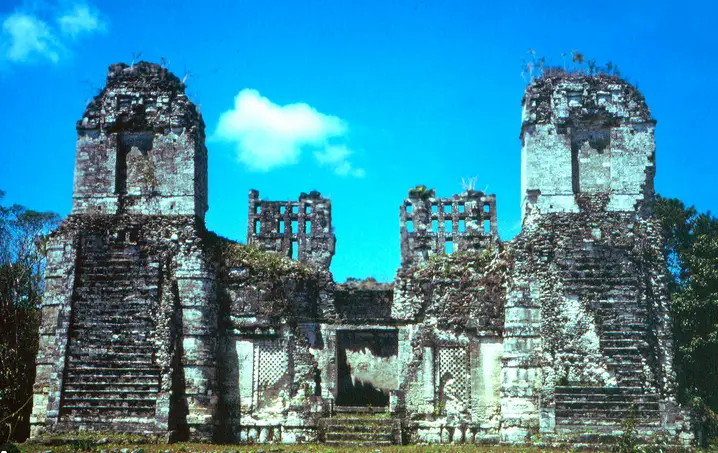 Nestled deep within the lush, untamed jungles of southern Campeche, Mexico, lies the archaeological site of Río Bec, a testament to the ingenuity and artistry of the ancient Maya civilization. This sprawling complex, far removed from the well-trodden tourist paths, represents not just a collection of ruins but a unique architectural style that has puzzled and fascinated scholars for over a century. Río Bec is more than a single location; it’s a dispersed network of monumental groups scattered across an endless, green landscape, embodying the Maya’s harmonious blend of human ambition and natural surroundings. Situated in the heart of the Yucatán Peninsula, near the Calakmul Biosphere Reserve, the site offers a glimpse into a society that thrived during the Late Classic Period, roughly from 600 to 900 AD. Its isolation, combined with its distinctive features, makes Río Bec a good example of the Maya’s decentralized power structures and their profound connection to the environment. As one ventures into this hidden realm, the ruins whisper stories of prosperous farmers, elite residences, and an architectural flair that imitated grandeur without the need for functionality.
The story of Río Bec begins with its elusive discovery, a tale that mirrors the site’s own mysterious nature. In the late 19th century, Austrian explorer Teoberto Maler first mentioned the site in his writings, though he never set foot there himself. It was French explorer Maurice de Perigny who, in the early 20th century, became the first European to document and report on the ruins. However, 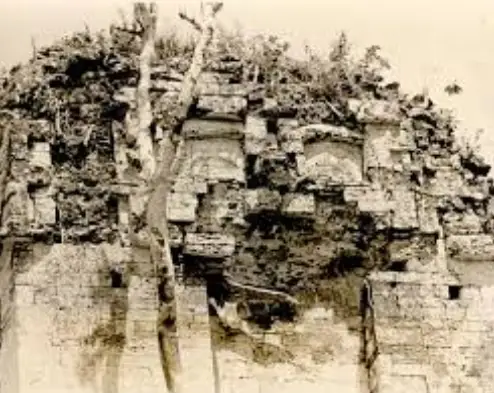 the true unveiling came in 1912 when American archaeologists Raymond E. Merwin and Clarence L. Hay stumbled upon what is now known as Group B during an expedition. Astonishingly, this group was “lost” again shortly after, vanishing into the dense jungle for 61 years. Despite multiple attempts by institutions like the Carnegie Institution of Washington in the 1930s, which uncovered nearby associated ruins, Group B evaded rediscovery until 1973. That year, a documentary film team from Princeton University, led by Hugh and Suzanne Johnston, along with Gillett Griffin and Andrea Seuffert, relocated it through an aerial search and ground exploration. This rediscovery highlighted the challenges of accessing Río Bec: the site is not connected by any ancient sacbé – raised roadways – or modern paths, and its groups are spread over approximately 12.5 square miles on elevated terrain amid seasonal wetlands.
Subsequent explorations have been methodical and interdisciplinary. French archaeologists from the National Center for Scientific Research, under the direction of Dominique Michelet, have led excavations since the early 2000s. Projects like Río Bec 1 – lasting from the years 2002 to 2010 – focused on mapping the settlement, analyzing architecture, and understanding the economy and social organization. The ongoing Río Bec 2 project which started in 2019 delves deeper into governance, land use, and the transitions from the Classic to Postclassic periods. These efforts have revealed that Río Bec was not a unified city with a central palace or temple but a collection of 73 monumental groups, primarily residential, interspersed with agricultural terraces. The site’s history traces back to the Middle Preclassic period around 300 BC, but its peak came during a rapid expansion from 700 AD onward, when earlier occupations were often plowed under or built over. By the 9th century, signs of crisis emerged, possibly linked to broader Maya collapses, leading to abandonment.
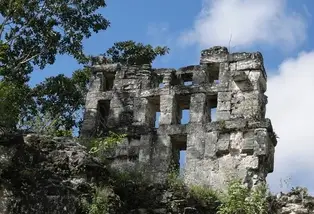 At the heart of Río Bec’s allure is its namesake architectural style, a flamboyant expression of Maya creativity that emerged in the central lowlands during the 7th century and persisted until the early 12th century. The Río Bec style is characterized by what scholars call “façade architecture”; buildings designed more for visual impact than practical use. Central to this are the iconic twin towers flanking low, range-type structures, often palaces or residences. These towers, which are solid masonry constructs, rise steeply with rounded corners to create an illusion of immense height. They feature faux stairways with steps that appear climbable but are impractically narrow and steep, serving as mere decorative motifs. At their summits sit pseudo-temples: solid masses with no interior rooms, adorned with niches simulating doorways but leading nowhere. These elements mimic the grand temple-pyramids of sites like Tikal in Guatemala, yet on a smaller, symbolic scale. The towers often incorporate zoomorphic masks, representing deities like Itzamná, the serpent creator-god, embedded in the upper friezes. Lower walls remain plain, contrasting with the ornate upper sections, while motifs like checkerboard patterns (symbolizing layers of existence) and cruciform designs (evoking cardinal directions) add symbolic depth.
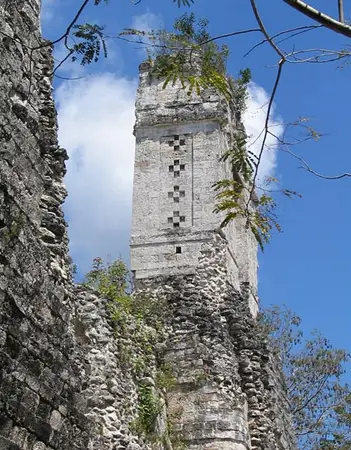 This style’s purpose remains enigmatic. Unlike functional pyramids used for rituals or burials, Río Bec’s towers were likely ceremonial, perhaps for offerings by elite individuals, such as ballgame players. The architecture suggests a shift toward symbolism over utility, where the exterior façade impressed visitors or conveyed status without the need for accessible interiors. Río Bec’s buildings also feature vaulted tunnels, decorative crests atop roofs called “roof combs” by architects, and geometric panels, blending with the Chenes style found to the northwest, which emphasizes monster-mouth doorways. The overall effect is one of showiness, as if the Maya here were emulating the grandeur of distant power centers like Tikal or Calakmul but adapting it to a more decentralized, agrarian society. This imitation might reflect political alliances or rivalries, with the Kaan dynasty’s influence possibly extending here, though evidence is sparse. The style spread to nearby sites, influencing structures in Becán, Xpujil, Chicanná, and Hormiguero, creating a regional network of similar aesthetics.
Delving into the site’s key structures reveals the diversity within this dispersed layout. Group B, the real heart of Río Bec, exemplifies the style with its scattered buildings around an irregular plaza. Structure 6N1 is a palace with twin towers, checkerboard panels, and a central burial, while 6N2 boasts ten chambers with painted benches, hinting at elite living quarters. 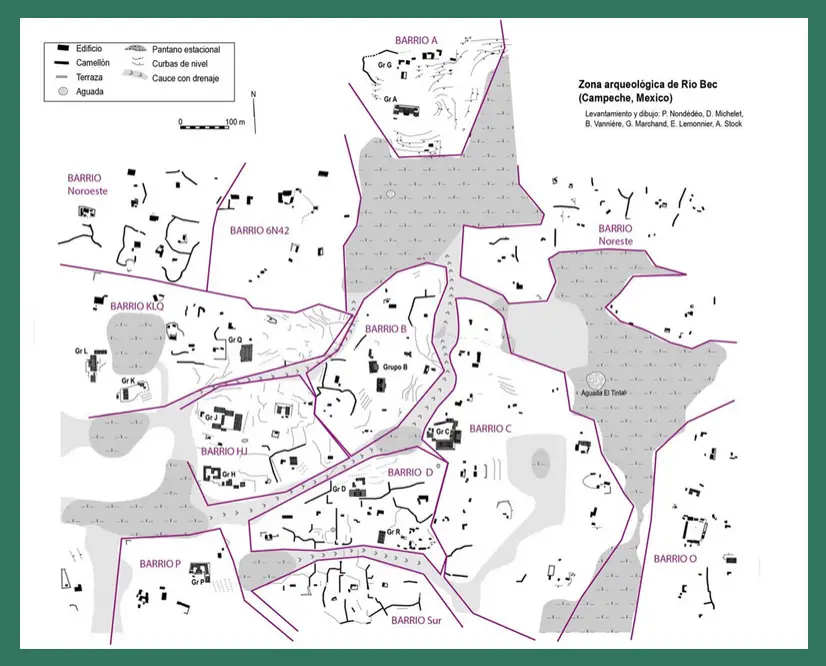 Nearby, Group A, just 900 feet north across a wetland, centers on a small patio with Structure 5N2. Structure 5N2 is a multi-room palace featuring fourteen chambers, pyramidal towers with faux stairways, and six decorative geometric panels. Smaller structures here served residential or storage purposes. To the northeast lies the Kajtun Group, a larger complex with a central plaza, sixty-two structures, including a pyramidal temple with stelae, and range-type galleries. Its satellite, the Dzibil Group, adds a pyramidal mound and inscribed stelae, some bearing family names like Dzib Tun, linking to modern Maya descendants. Group II, with Middle Preclassic roots, includes an “E” Complex for astronomical observations, a large pyramid, and a ballcourt which rare civic elements in Río Bec. Stelae here bear inscriptions, offering glimpses into rituals or rulership. Group V, northwest of B, features another ballcourt, a massive platform, and a stela dated to 869 AD, suggesting late attempts at establishing dynastic rule amid societal shifts. Smaller groups like D, with graffiti-adorned structures and burials, and residential clusters fill out the landscape, emphasizing Río Bec’s non-hierarchical nature. Unlike centralized Maya cities, there’s no grand plaza or acropolis; instead, groups are autonomous, bounded by fields and terraces, supporting a population of prosperous farmers.
Culturally, Río Bec paints a picture of a society focused on agriculture and self-sufficiency rather than empire-building. The vast terrace systems, still visible today, indicate intensive farming adapted to the tropical lowlands, with rainwater collection in lieu of rivers, hence the name “Río Bec,” evoking a “river” of bec trees rather than water. Monumental groups served as elite residences, with modest houses nearby, suggesting a stratified yet egalitarian structure. Evidence from excavations points to an oligarchic governance, where power was shared among families rather than centralized in a divine king. This contrasts with sites like Calakmul, where monumental architecture signified royal authority. Artifacts, including stelae with eroded glyphs, pottery, and offerings in niches, reflect daily life, rituals, and beliefs in duality—life and death, east (birth) and west (transition)—symbolized by carved serpents and inverted T-windows peering into Xibalba, the underworld.
The site’s integration with the jungle showcases Maya environmental wisdom. Structures blend seamlessly with nature, often reclaimed by vines and trees, creating a living museum. Medicinal plants abound, serving as a “jungle pharmacy,” with remedies for ailments like kidney stones or rashes. Wildlife, from wild pigs to exotic birds, adds to the ambiance, while the quiet energy of the ruins invites reflection. Modern Maya descendants, like guides from nearby ejidos, maintain cultural ties, protecting the forest and sharing oral histories.
Río Bec’s influence extends to the surrounding region, where the style defines a cluster of sites along Highway 186. Becán, the political capital of the Río Bec province, features a unique moat encircling its core, and grand structures like Structure I with vaulted tunnels and towers. Xpujil, Chicanná, and Hormiguero display similar faux temples and zoomorphic entrances, forming an itinerary for explorers. These sites are all part of the UNESCO-listed Ancient Maya City and Protected Tropical Forests of Calakmul. Together, they illustrate the Late Classic’s artistic richness, amid political flux and environmental challenges.
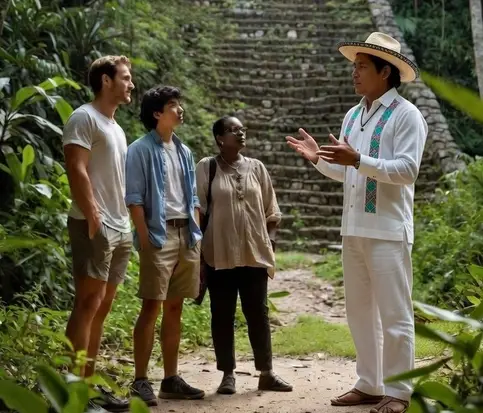 Today, Río Bec remains off the beaten path, not officially open to the public, preserving its mystique. Access requires guides from local villages, often via ATVs over rough trails. A trip to the ruins is an adventure involving jungle treks, quad rides through potholes, and encounters with local flora and fauna. Preservation efforts, supported by Mexico’s National Institute of Anthropology and History or INAH, and international teams, focus on mapping, conservation, and studying climate impacts. Tourism is minimal, emphasizing sustainable visits that respect the biosphere reserve. Challenges include deforestation and looting, but community involvement fosters protection.
Río Bec stands as an enigmatic jewel of Maya heritage, where architecture transcends function to embody symbolism and status. Its dispersed building clusters, innovative style, and jungle embrace offer profound insights into a civilization that balanced human endeavor with nature’s rhythms. As excavations continue, Río Bec promises more revelations about the Maya’s resilient spirit, inviting us to ponder the echoes of ancient worlds hidden in Mexico’s green depths.
REFERENCES
Maler, Teoberto. “Explorations in the Department of Peten, Guatemala and Adjacent Region.” Memoirs of the Peabody Museum of American Archaeology and Ethnology, vol. 4, no. 3. Cambridge: Harvard University, 1908.
Merwin, Raymond E., and Clarence L. Hay. The Ancient Maya City of Rio Bec. Washington, D.C.: Carnegie Institution of Washington, 1913.
Michelet, Dominique. “The Río Bec Project: An Introduction.” In Maya Archaeology: Reports from the Río Bec Project, edited by Dominique Michelet, 1-15. Paris: CNRS Éditions, 2011.