
Podcast: Play in new window | Download
Subscribe: Apple Podcasts | RSS
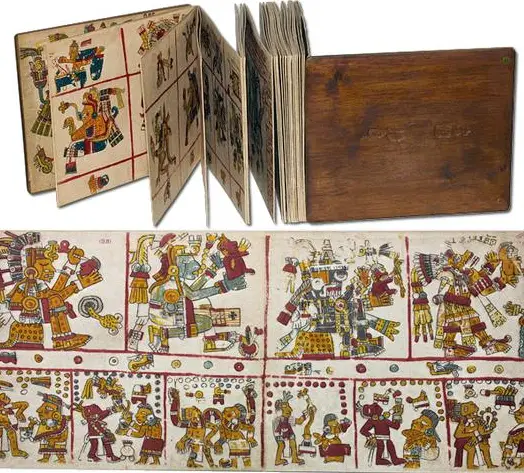 The Vatican’s vast collections, renowned for Renaissance masterpieces and sacred relics, also safeguard extraordinary windows into the sophisticated civilizations of pre-Columbian Mexico. These ancient Mexican artifacts—primarily pictorial manuscripts known as codices, along with sculptures and other objects—represent rare survivors from a world of intricate calendars, powerful deities, and vibrant ritual life that flourished before the Spanish conquest in the early 16th century. Most indigenous books and many artworks were deliberately destroyed by Spanish authorities and missionaries who viewed them as idolatrous. The handful that reached Europe, often through missionary channels, offer invaluable insights into Aztec, Mixtec, Maya and related Mesoamerican worldviews. Today, these treasures reside in the Apostolic Library and the Anima Mundi Ethnological Museum, formerly known as the Missionary Ethnological Museum. They arrived via complex routes involving Dominican friars, antiquarian collectors like Cardinal Stefano Borgia, diplomatic gifts, and the landmark 1925 Vatican Missionary Exposition. While not the largest collection outside Mexico, the Vatican’s holdings stand out for their quality, preservation, and scholarly significance.
The Vatican Library preserves some of the most important surviving pre-Columbian and early colonial Mesoamerican codices. These screenfold or bound manuscripts, painted on deerskin or European paper, functioned as sacred books encoding calendars, divination, rituals, history, and cosmology. Unlike European books with linear text, they rely on a sophisticated pictorial system combining glyphs, figures, colors, and spatial arrangements that trained specialists called tlacuiloque could “read.” Only about 15 to 20 pre-Columbian codices survive worldwide; the Vatican holds two of the finest from the Borgia Group, plus a major colonial example. Their content reveals a worldview in which time itself was divine, every day carried specific energies and patron deities, and divination guided decisions from agriculture to warfare and personal fate.
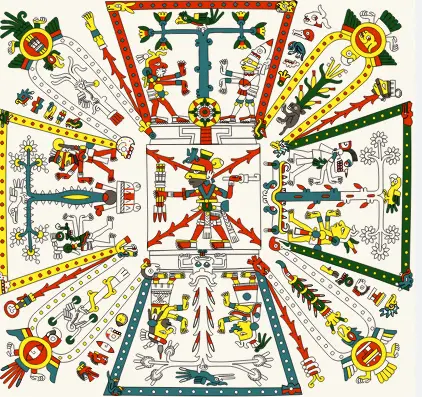 The Codex Borgia stands as one of the most spectacular and extensively studied. Created in central Mexico during the late Postclassic period (roughly 1450–1500 or slightly later), likely in the Puebla-Tlaxcala or Mixtec-Puebla region, it is a screenfold manuscript made of deerskin sheets joined into a long strip and folded accordion-style. When fully unfolded, it measures over 36 feet long. It comprises 39 sheets forming 78 pages – 76 of which are painted – each roughly 10 and a half inches by 10 and a half inches —nearly square for easy viewing when folded or partially opened. Artists prepared the surface by coating the deerskin with white gypsum-based plaster, creating a smooth, bright canvas. They used precise black contour lines and polychrome washes in a limited but vibrant palette, achieving remarkable density and artistic sophistication. The manuscript divides into about 28 sections, most devoted to the 260-day divinatory calendar central to Mesoamerican life. The first eight pages present the full sequence of 260 day signs in horizontal rows, grouped into 20 13-day periods. Each day sign appears with associated mantic symbols—above and below—indicating favorable or unfavorable outcomes for activities. Footprint glyphs sometimes mark paths or journeys. Subsequent sections detail patron deities for each day sign, the nine Lords of the Night, directional almanacs linked to the four cardinal directions and cosmic trees, rain almanacs with Tlaloc imagery, Venus cycles, birth and marriage prognostications based on day-sign combinations, and rituals involving fire-drilling, sacrifices, temple dedications, and agricultural festivals. Scholars consider it among the richest sources for Central Mexican gods, ritual practices, and iconography. It belongs to the “Borgia Group” of stylistically related manuscripts sharing content and Mixteca-Puebla artistic traditions.
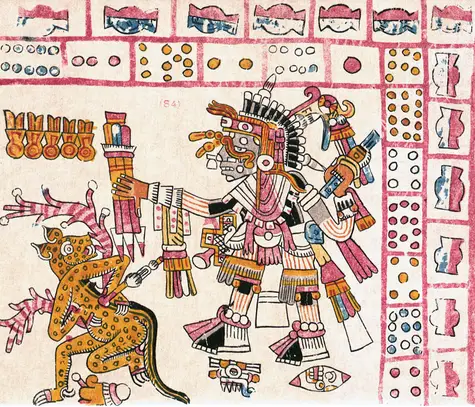 Codex Vaticanus B, another pre-Columbian member of the Borgia Group, complements the Borgia Codex beautifully while differing in scale and emphasis. Smaller and more compact, it is a screenfold of ten deerskin segments joined and folded accordion-style into 49 pages, each about 5.75 inches by about 5 inches. Its total unfolded length is roughly 23.75 feet. The surface features bright white burnished gesso, red framing lines, black outlines, and a restricted palette of about six colors. It retains original wooden covers – including one still with a turquoise mosaic tile – suggesting it was once a prized ritual object. Divided into 31 sections, it focuses intensely on the calendar. It includes an almanac spanning the first pages, grouped day lists associated with deities in temples or constructions, almanacs for specific activities like digging or agriculture, directional and rain charts, birth and marriage prognostications, Venus tables, body-part almanacs linking anatomy to days and gods, and sequences involving the Cihuateteo, or the spirits of women who died in childbirth, and the 5 Aztec gods of pleasure or the Macuiltonaleque. Both Borgia Group codices likely originated in the same broad cultural sphere (Puebla-Oaxaca borderlands or central highlands) decades before the Spanish arrival. They survived because they were carried or sent to Europe early in the colonial period, escaping the widespread religious destruction of ancient artifacts. Their overlapping yet distinct content allows scholars to reconstruct lost originals and understand regional variations in divination and ritual.
Codex Ríos – also known as Codex Vaticanus A – bridges the pre-Columbian and colonial worlds. Produced in the mid-to-late 16th century on European paper (approximately 102 folios, 46.5 by 29.5 cm), it is not a pure indigenous manuscript but an Italian translation and expansion of an earlier Aztec pictorial source. It spans 102 pages and measures over 18 inches by a little over 11.5 inches. Illustrations were likely executed by an Italian artist in Rome, while annotations in cursive Italian are attributed to or drawn from the work of Pedro de los Ríos, a Dominican friar active in New Spain from 1547 to 1562. It may derive partly from the Codex Telleriano-Remensis or a related lost manuscript, with additions covering the early conquest period absent from some parallels. Organized into thematic sections, it opens with cosmology and cosmogony: depictions of the heavens, pre-Hispanic “giants,” and the four previous world ages or “suns” which were distinct eras destroyed by cataclysms. It includes a detailed calendrical divinatory almanac with deities and supernatural influences, tables for the 18-month festival calendar, ethnographic material on sacrificial and funerary rites, portraits of indigenous people in traditional dress, and extensive pictorial historical chronicles. These annals trace migrations from Chicomoztoc (the legendary Seven Caves) events in the Valley of Mexico, rulers, military campaigns, celestial phenomena, and the Spanish conquest up to the mid-1500s. It functions as both a record of indigenous knowledge and a tool for European understanding, sometimes with Christianized or comparative notes.
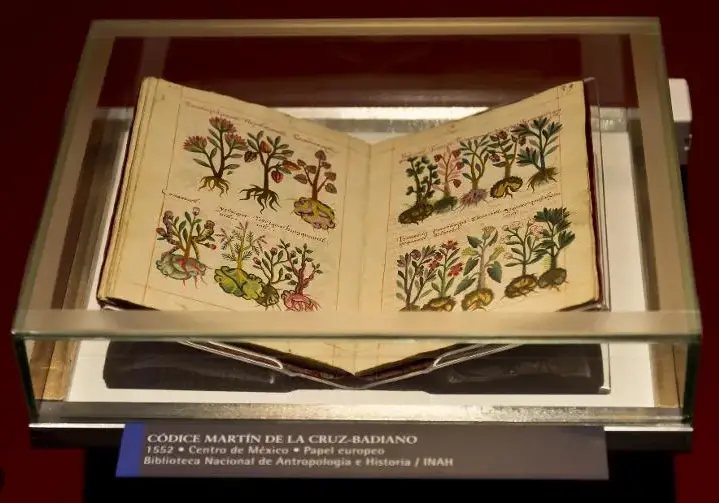 The Badiano Codex represents another colonial achievement which once resided in the Vatican archives. Compiled in 1552 at the College of Santa Cruz in Tlatelolco by indigenous physician Martín de la Cruz, it was written in Nahuatl and translated into Latin by Juan Badiano. It is the earliest known illustrated treatise on New World medicinal plants and treatments. Featuring detailed botanical illustrations and descriptions of herbal remedies, it preserves indigenous pharmacological knowledge. The original spent centuries in the Vatican before Pope John Paul II returned it to Mexico in 1990 following restored diplomatic relations; the Library retains a high-quality copy. These codices are not mere curiosities but profound intellectual achievements. They demonstrate advanced systems of timekeeping, symbolic communication rivaling writing systems elsewhere, and a holistic integration of astronomy, religion, medicine, and history. Modern scholars use facsimiles and digitizations for ongoing research into Mesoamerican thought. Their survival underscores resilience amid cultural upheaval.
Beyond manuscripts, the Anima Mundi Ethnological Museum houses three-dimensional pre-Columbian objects from Mesoamerica. The most celebrated is the Aztec sculpture of Quetzalcoatl, the Feathered Serpent dating to the late empire. Carved from reddish stone as a coiled monolith, it depicts the deity in animal form with realistic details: a head with small round eyes and dilated nostrils, a mouth with forked tongue, a rattle tail, and relief feathers covering the body. Quetzalcoatl embodied creation, the calendar, agriculture, crafts, and the priestly class and is often contrasted with his dualistic counterpart Tezcatlipoca. This piece, considered one of the Vatican’s top treasures alongside Michelangelo works, entered the collections via the Borgia Museum and was donated to Pope Pius XI.
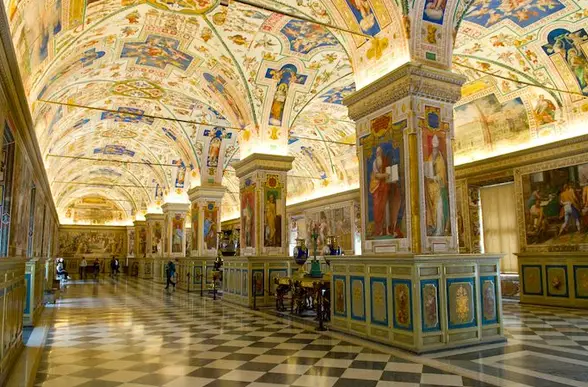 Additional examples in the Vatican enrich the survey. The collection includes ceramic vessels and figurines from Aztec and related Mesoamerican contexts. These often portray deities, ritual participants, or symbolic motifs, showcasing advanced pottery techniques that parallel codex iconography. They illuminate daily and ceremonial life. Stone carvings and tools, including smaller obsidian or basalt items and votive figures, represent ritual or utilitarian objects. These echo early 16th-century gifts of hard-stone artifacts and demonstrate skilled lapidary work—polishing, carving, and inlay—central to Mesoamerican aesthetics and symbolism. Finally, small gold or gold-copper-alloy votive figures and pendants appear among the pre-Columbian metal holdings. Crafted via lost-wax casting, these miniature ornaments served in offerings or as status symbols, highlighting elite artistry and religious practices.
Many artifacts reached the Vatican through 16th-century Dominican missionaries. Friar Domingo de Betanzos presented gifts—including painted books, featherworks, and stone items—to Pope Clement VII in 1532 during visits to Rome and Bologna. Later Dominican channels brought additional manuscripts. Cardinal Stefano Borgia’s extensive collection supplied key pieces, transferred to the Vatican Library in 1902. The 1925 Missionary Exposition and subsequent museum founding by Pius XI incorporated ethnographic material from missionaries worldwide. Diplomatic gifts and later donations further increased the ancient Mexican holdings.
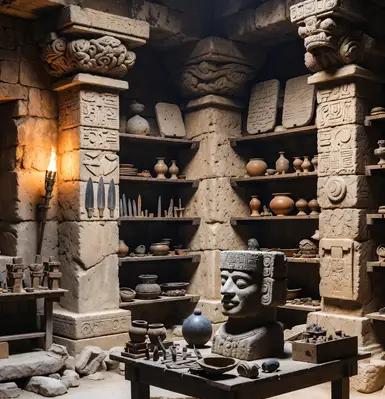 The institution’s major holdings are well-documented, studied by international scholars, and increasingly accessible through digitization and publications. The Anima Mundi collection -now exceeding 80,000 objects worldwide – emphasizes transparency and cultural dialogue, with recent renovations highlighting the Americas section. Mexico has pursued collaborative research on Vatican-held historical materials, underscoring shared stewardship rather than secrecy. However, speculation about undisclosed “hidden” Mexican artifacts in the Vatican vaults occasionally surfaces in popular discussions, often tied to broader conspiracy narratives about suppressed ancient knowledge. One such theory is that the Vatican houses the complete collection of the vast library of the Kingdom of Texcoco in an undisclosed location. Most people who know even a little about Mexican history know of the 1562 public book burning and artifact destruction in the Maya area committed by Bishop Diego de Landa talked about in Mexico Unexplained Episode 106: https://youtu.be/oHXhaIRzLcs While certainly tragic, this is by far not the largest disappearance of tangible Mesoamerican knowledge after the Conquest and may be a historical sleight of hand being played to distract us. The Kingdom of Texcoco was a wealthy Nahua kingdom located on the eastern shores of the lake of the same name. The old royal house of the kingdom patronized the arts much like the Medici of Florence and built a gigantic library, said to rival that of Alexandria in the Classical World. While early Spanish accounts record such a library, immediately after the Conquest not a word more is mentioned of it in the historical record. The library was said to have contained hundreds if not thousands of documents from several different ancient Mexican civilizations dating back over a thousand years. It was also rumored to have had ancient Mesoamerican artifacts that would rival any modern museum. Some researchers suggest that the contents of the Royal Library of Texcoco were carted off to Rome thus giving the Pope and the church elites access to this ancient esoteric knowledge. The Vatican has denied everything to do with this and has been clear in its position that what they have already shown to the public is the extent of what they possess. Fringe researchers aren’t buying it. Do you?
REFERENCES