
Podcast: Play in new window | Download
Subscribe: Apple Podcasts | RSS
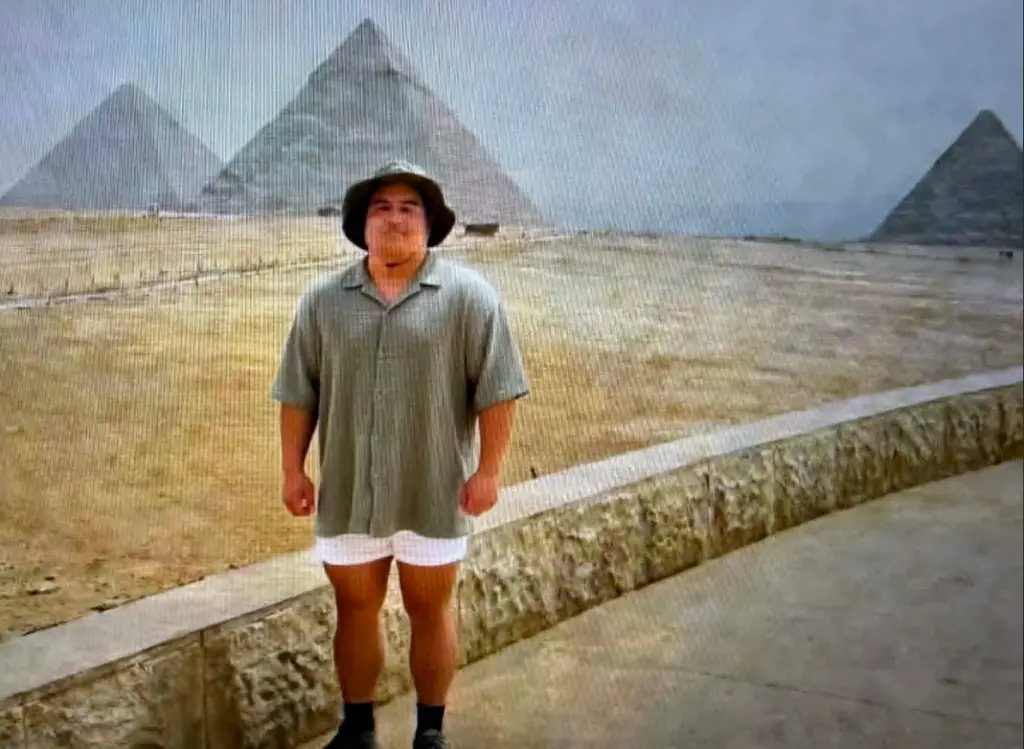 Standing beneath the towering limestone blocks of the Great Pyramid at Giza just weeks ago, I felt the same awe that countless travelers have described for millennia. The precision of the engineering, the sheer scale reaching toward the sky, the sense that this structure was built not just for the dead but for eternity itself—all of it lingered with me as I boarded my flight home. Yet as someone who has also explored the stepped temples of Teotihuacan and the jungle-shrouded pyramids of the Maya, one thought kept returning: how could two civilizations, separated by vast oceans and thousands of years with no evidence of contact, produce such strikingly similar achievements? Ancient Egypt along the Nile and the cultures of ancient Mexico—primarily the Maya in the Yucatán and southern regions, and the later Aztecs in central Mexico—developed in complete isolation. Their parallels are not the result of diffusion or ancient voyages but of convergent evolution: similar human needs, environments, and ambitions giving rise to parallel solutions. This episode of Mexico Unexplained explores nine key similarities in depth, weaving together architecture, writing, religion, governance, timekeeping, and material culture to reveal what they tell us about the universal patterns of human civilization.
The first key similarity is perhaps the most iconic image of both worlds: the pyramid. In ancient Egypt, these structures evolved from the stepped mastabas of the Early Dynastic period into the 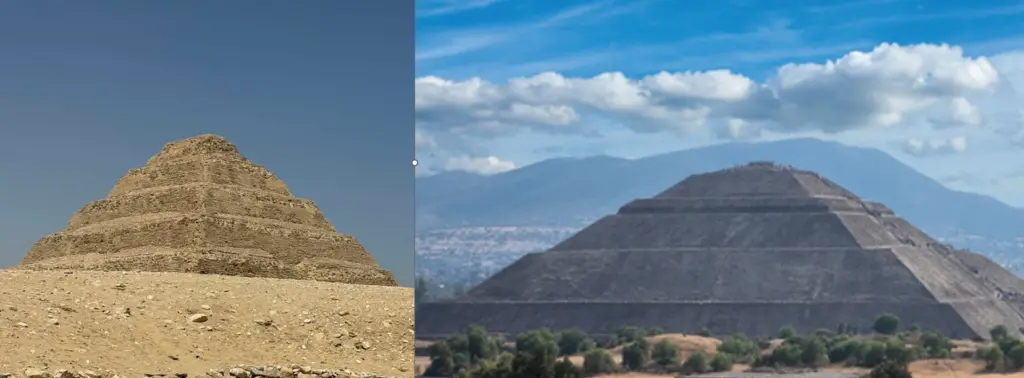 smooth-sided marvels of the Old Kingdom, such as the pyramids of Giza built around 2580 to 2560 BC for pharaohs like Khufu, also known as Cheops. They served primarily as tombs, designed to protect the royal body and facilitate the soul’s journey to the afterlife amid precise cardinal alignments. In ancient Mexico, the pyramids of the Maya and Aztecs remained stepped, functioning as elevated temple platforms rather than sealed tombs. The Pyramid of the Sun at Teotihuacan, rising over 200 feet, and El Castillo at Chichen Itza with its nine terraces and serpent-shadow effect on the equinoxes, hosted rituals, sacrifices, and astronomical observations. Both societies oriented these monuments to the heavens, using them to connect earth and cosmos. The visual similarity strikes every visitor, yet the functions diverged: Egyptian pyramids hid the dead in secrecy, while those in ancient Mesoamerica invited public ceremony and communal awe. This shared architectural impulse reflects a common drive to monumentalize power and the sacred in societies reliant on intensive agriculture and centralized authority.
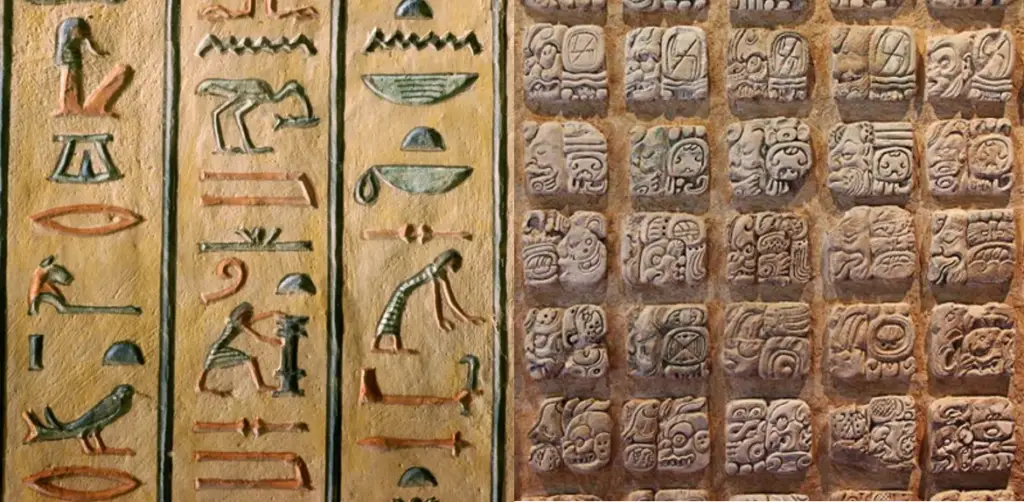 Closely tied to these grand constructions were sophisticated systems of writing that employed logograms, which are symbols representing words or ideas alongside phonetic elements. Egyptian hieroglyphs, emerging around 3200 BC, combined pictorial signs with sound values and determinatives, carved into temple walls, tombs, and papyri to record history, religion, and administration. Scribes, an elite class, used this script for everything from royal decrees to funerary spells. In Mesoamerica, the Maya developed one of the most complex writing systems in the ancient world, a logosyllabic script with hundreds of glyphs that blended logograms for concepts with syllabic signs for sounds. Inscriptions on monuments, codices, and pottery detailed kings’ deeds, astronomical events, and mythic narratives. The Aztecs, building on earlier traditions, used a more pictographic system with logographic elements in their codices. Both cultures reserved literacy for priests and elites, using it to legitimize rule and preserve knowledge across generations. The resemblance is uncanny: flowing, artistic signs that feel alive on stone or paper, encoding not just facts but ideology. Without any transoceanic exchange, both societies independently invented durable visual languages to immortalize their worldviews.
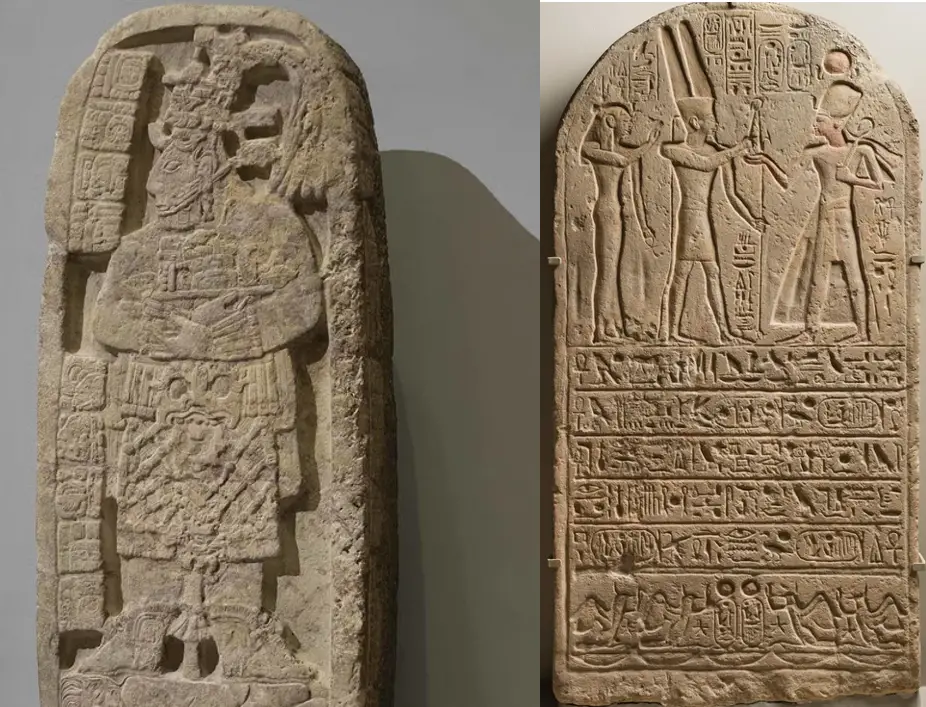 These writings often appeared on stelae—tall, upright stone slabs—that served as public billboards of divine favor and royal prowess. Egyptian stelae, such as those from the New Kingdom, proclaimed victories, offerings to gods, and pharaonic achievements, often placed in temples or tombs. Maya stelae, found across sites like Copán and Tikal, were even more elaborate: intricately carved with portraits of kings in regalia, accompanied by long glyphic texts recounting accessions, wars, and rituals. They stood in plazas, visible to the populace, broadcasting the ruler’s connection to the gods. Both traditions used these monuments to blend history with propaganda, ensuring that the deeds of the elite endured in stone. The stelae embodied a shared cultural strategy: public art as political and religious theater, reinforcing social hierarchy in societies where oral tradition alone could not suffice for complex states.
Religion permeated every aspect of life in both civilizations, nowhere more evident than in their views of death and the afterlife. The Egyptian god Anubis, depicted with the head of a jackal, guarded tombs, oversaw mummification, and guided souls through the underworld to the Hall of Judgment. His canine form evoked the scavenging desert dogs that haunted burial grounds, transforming a practical observation into a divine protector. In Aztec belief, the dog-headed god Xolotl, a twin of Quetzalcoatl, accompanied souls on the perilous journey through Mictlan, the nine-layered underworld. The hairless Xoloitzcuintli breed was bred specifically for this role; dogs were buried with the dead to serve as guides, their loyalty mirroring Xolotl’s. Both cultures saw the afterlife as a dangerous voyage requiring supernatural canine assistance, reflecting deep anxieties about mortality and the unknown. Funerary practices diverged—Egyptians mummified bodies for eternal preservation, while Mesoamericans focused on offerings and rituals—but the “spirit guide” role of the dog bridged their cosmologies in a profound, almost poetic way.
Governance revealed another parallel in the exceptional roles of women. Hatshepsut, who ruled Egypt as pharaoh from 1479 to 1458 BC during the Eighteenth Dynasty, assumed full kingly authority after her husband’s death. She commissioned massive building projects, led expeditions, and was depicted in statues wearing the male kilt, false beard, and the iconic striped cloth headdress, which were traditional symbols of pharaonic power. Her reign brought prosperity, yet later rulers attempted to erase her from history, underscoring the rarity of female rule. In the Maya world, queens like Lady Six Sky of Naranjo who ruled in the seventh century AD exercised comparable authority. Sent from Dos Pilas to revive a weakened city, she acted as regent and warrior leader, commissioning stelae that portrayed her in kingly regalia, overseeing conquests, and performing rituals usually reserved for male rulers and priests. Other Maya queens at Palenque and Yaxchilan similarly stepped into power during crises, blending maternal and martial roles. In both societies, patriarchal norms prevailed, yet pragmatic necessity and divine legitimacy allowed select women to transcend gender expectations, adopting male iconography to maintain dynastic continuity. This flexibility highlights how both cultures prioritized stability and lineage over rigid gender roles when the divine order demanded it.
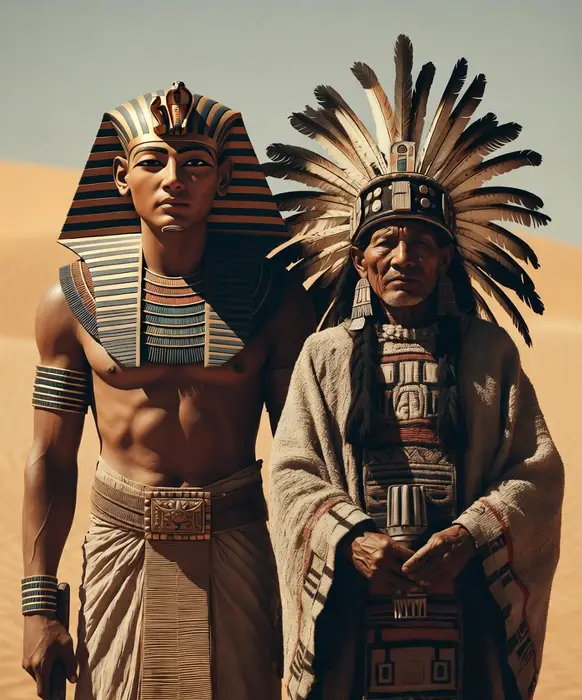 At the apex of power stood rulers who were viewed as divine or semi-divine. Egyptian pharaohs embodied Horus in life and Osiris in death, considered living gods whose words maintained ma’at, or the cosmic balance. Their every action, from temple rituals to military campaigns, reinforced this god-king status. Mesoamerican kings, whether Maya ahaw or Aztec tlatoani, claimed descent from deities and performed rituals impersonating gods to ensure fertility, victory, and cosmic order. They wore elaborate headdresses and jade regalia symbolizing their intermediary role between humans and the supernatural. Both systems fused political and religious authority into one sacred office, with the ruler’s body and blood literally sustaining the universe. This divine kingship stabilized vast territories by making obedience a religious imperative.
Time itself was mastered through complex calendars intertwined with advanced astronomy. Egyptians developed a 365-day solar calendar based on the Nile’s annual flood and the rising of the star Sirius, dividing the year into three seasons for agriculture and festivals. Priests tracked stars for religious timing, aligning pyramids and temples with celestial events. The Maya created not one but multiple interlocking calendars: the 365-day Haab’ for civil affairs, the 260-day Tzolk’in for ritual and divination, and the Long Count for deep historical reckoning. Their astronomers achieved remarkable precision, predicting eclipses and Venus cycles centuries ahead, and oriented entire cities—like the solstice alignments at Chichen Itza—to mirror cosmic rhythms. Aztec calendars built on these foundations, featuring a 365-day solar year and a ritual calendar that governed sacrifices. Both civilizations understood that accurate timekeeping was essential for agriculture, religion, and legitimacy; misaligned seasons could spell famine or divine displeasure. Their observatories—Egyptian temple alignments and Maya pyramid sightlines—embodied a shared quest to harmonize human life with the heavens.
Central to these religious and calendrical systems were prominent sun gods who embodied life, power, and renewal. In Egypt, Ra (later Amun-Ra) reigned supreme as creator and sustainer, traversing the sky by day and the underworld by night in his solar barque. Pharaohs were his earthly sons, and temples like Karnak centered on his cult. Among the Aztecs, Huitzilopochtli—the hummingbird of the south—served as both sun god and patron of war, demanding tribute and sacrifice to ensure the sun’s daily rebirth. The Maya honored Kinich Ahau, the jaguar-faced sun deity whose journey mirrored the ruler’s own. In both pantheons, the sun’s cycle symbolized the eternal struggle against chaos, with kings and priests tasked to sustain it through ritual. Polytheism flourished alongside this solar focus, yet the sun’s centrality unified cosmology, agriculture, and kingship across continents.
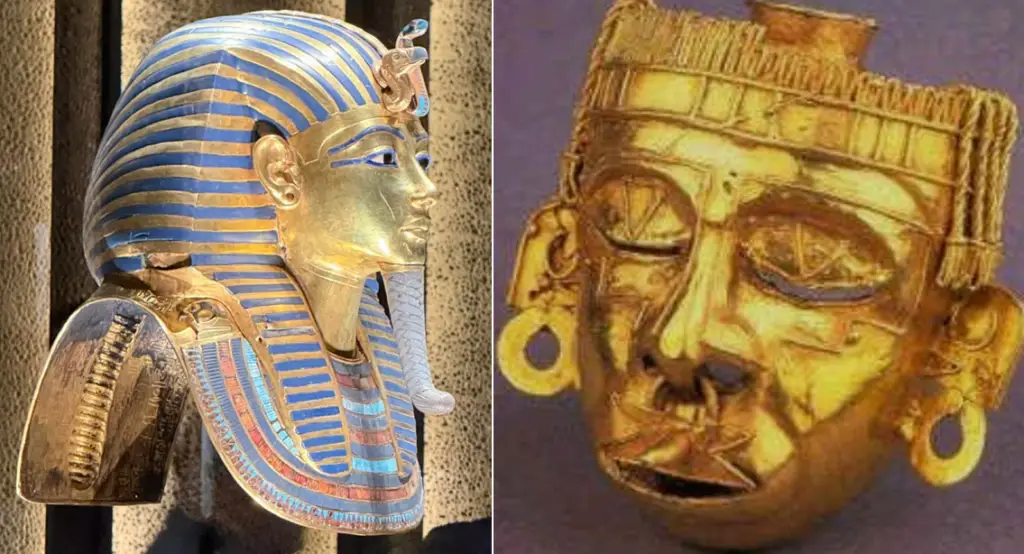 Finally, both cultures placed extraordinary value on gold as a material of divinity and eternity. Egyptians mined it from Nubia and the Eastern Desert, calling it the “flesh of the gods” for its untarnishing brilliance that evoked the sun’s rays. Gold adorned pharaohs’ masks, coffins, and jewelry—most famously Tutankhamun’s treasures—symbolizing immortality and divine favor. It filled tombs to accompany the soul, its incorruptibility mirroring the afterlife ideal. In ancient Mexico, the Aztecs revered gold as the “excrement of the gods,” a sacred substance linked to the sun and elite status. Artisans crafted intricate pectorals, masks, and ritual objects from it, often melted down from offerings or tribute gathered from far-flung provinces of the empire. While Maya elites prized jade more for its life-giving green, gold held similar prestige in later periods, used in funerary contexts and temple adornments. Both societies controlled gold through royal or priestly monopolies, transforming a rare metal into a tangible link between mortals and the divine.
These nine parallels paint a portrait of two civilizations that, despite profound differences arrived at remarkably similar expressions of human aspiration. River valleys and fertile lands fostered agriculture, which in turn supported population growth, specialization, and hierarchy. Priests and kings channeled surplus labor into monuments that proclaimed order amid chaos. Writing and calendars tamed time and memory. Religion wove the mundane with the cosmic, ensuring that even the sun’s journey depended on human devotion. Gold and divine regalia elevated the elite, while exceptional women occasionally rewrote the rules of power. What does this convergence mean for people in the modern world? It underscores a profound truth about humanity: given the right conditions—stable food production, social complexity, and a need to explain the universe—our species repeatedly invents similar tools for survival and meaning. No ancient astronauts or lost continents are required; the human mind, observing the same stars, rivers, and seasons, arrives at parallel innovations. It also serves as a reminder that the past is not a foreign country but a mirror. Ancient Egypt and ancient Mexico did not meet, yet they speak to each other—and to us—in the universal language of ambition, reverence, and ingenuity. In a world that often feels divided, their stories unite us in wonder.
REFERENCES